


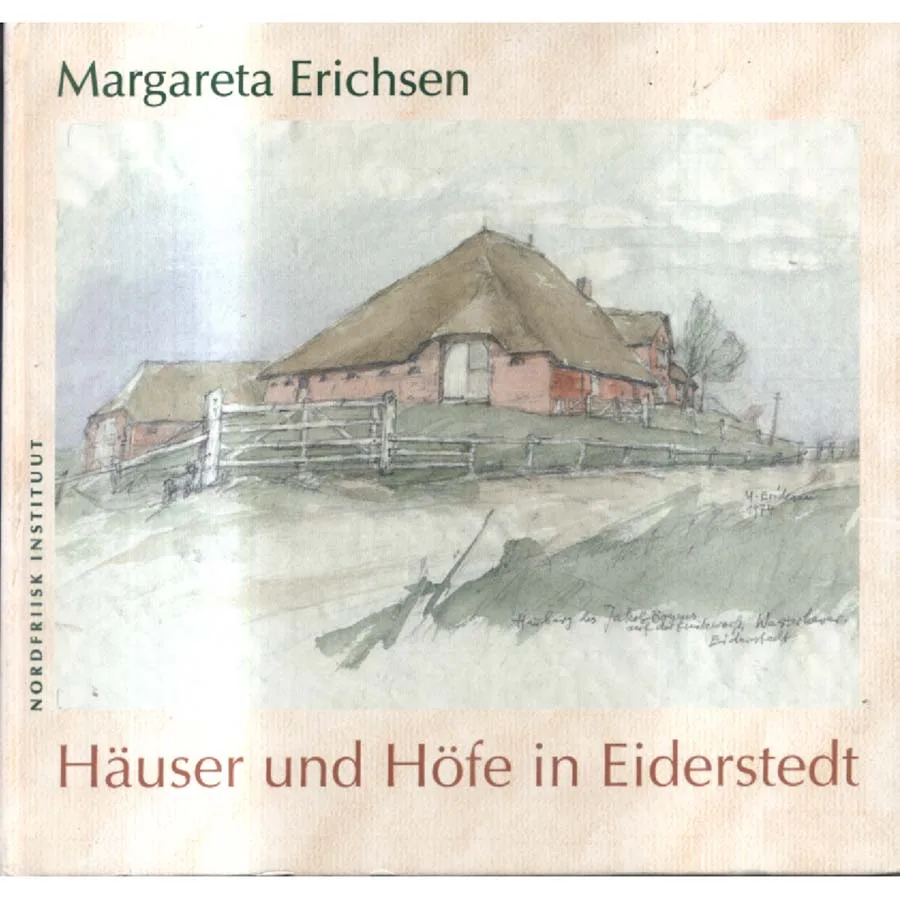
Hauser Und Hofe In Eiderstedt
Publisher: Verlag Nordfriisk Instituut
Format: Hardback
ISBN: 3880072582
Hauser und Hofe in Eiderstedt (1998) by Margareta Erichsen
Verlag Nordfriisk Instituut | ISBN: 3880072582
Condition: Very Good
As sold by Crappy Old Books
Some books concern themselves with grand empires, dramatic battles, or the rise and fall of civilisation. Others devote their energies to something arguably more impressive: old houses, farmsteads, and the accumulated architectural stubbornness of a particular corner of northern Europe. Hauser und Hofe in Eiderstedt belongs to this nobler tradition. It is a book about buildings, landscape, regional identity, and the quiet persistence of people who clearly believed that if one was going to erect a farmhouse in wind-battered Schleswig-Holstein, one might as well do it properly.
Eiderstedt, for those not already spending their evenings in a whirl of Frisian topography, is a peninsula in North Frisia with a distinctive rural and architectural heritage. This book appears to celebrate precisely that world: the houses and homesteads that formed the backbone of local life, standing there with admirable solidity while weather, history, and changing fashion did their best to interfere. These are not frivolous buildings. They are structures with purpose, dignity, and the sort of practical beauty that emerges when generations of people have to live with the consequences of design.
Margareta Erichsen’s work is likely to appeal especially to that excellent breed of reader who can become deeply interested in rooflines, brickwork, layout, regional style, and the social history concealed within timber and tile. There is a special pleasure in books like this, because they remind us that architecture is not merely about monuments and famous names. It is also about ordinary life made visible: where people slept, cooked, stored grain, endured winters, raised families, argued, prospered, and probably tracked a discouraging amount of mud across the threshold.
The title itself has a wonderful firmness to it. Hauser und Hofe in Eiderstedt does not overpromise. It is not trying to dazzle you with marketing tricks or pretend that rural building history is a form of adrenaline entertainment. It knows exactly what it is: a serious, regionally grounded study of houses and farmsteads, and all the better for it. The people who want this sort of book will want it very much indeed, while everyone else will at least have to admit that it sounds impressively specific.
Published in 1998 by Verlag Nordfriisk Instituut, this is the sort of handsome regional history volume that suggests scholarship, local pride, and a commendable resistance to the idea that every book must be simplified for the distracted modern passer-by. It belongs to that admirable category of books produced because the subject matters, not because anyone imagined it would end up stacked in airport kiosks beside celebrity memoirs.
There is also an irony, of course, in the fact that books about preserving regional heritage so often become heritage objects themselves. Here is a late twentieth-century study of older buildings, now itself growing pleasantly older and circulating through the second-hand book trade, where it may one day be appreciated as a period artefact in its own right. One can only hope it approves of the arrangement.
This copy is in very good condition, meaning it has survived with considerably more grace than many modern publications ever achieve. It remains an attractive and highly usable volume, ready either for scholarly consultation, regional interest, architectural browsing, or simply the pleasure of owning a book whose subject is so gloriously, unapologetically particular.
A fine acquisition for readers interested in German regional history, vernacular architecture, North Frisian heritage, rural buildings, or the broader cultural romance of old houses that have outlived most human schemes. It is an ideal book for anyone who has ever looked at a sturdy farmhouse and thought, with proper respect, “Yes, that seems built to outlast both fashion and nonsense.”
Keep browsing: See more German books Other books by Margareta Erichsen
